Should I Set Up a Holding Company for My Multiple Businesses?
By Valentis · Updated April 2026 · 14 min read
Running two or more companies from the same ownership raises a specific set of tax and structural questions. Around 40% of UK owner-managed businesses with multiple entities already use some form of group structure for tax planning. Whether that structure is right for you depends on three things.
The honest answer: it depends on three things
A holding company structure is not automatically the right answer for every director who owns more than one business. Some multi-business owners are better served by standalone companies with no group relationship at all. The structure earns its place when certain conditions apply.
If two or more of the following are true for you, the structure is worth modelling seriously.
Most compliance-focused accountants do not proactively model group structures. The conversation requires understanding your future intentions, not just your current numbers. If your accountant has never asked whether you plan to exit any of your businesses, or whether profits are accumulating inside them, this is a reasonable explanation for why it has not come up.
Is a holding company right for your businesses?
Tick everything that applies. The score gives a directional read, not a professional opinion.
Answer the questions above to get a directional assessment.
What a holding company actually is
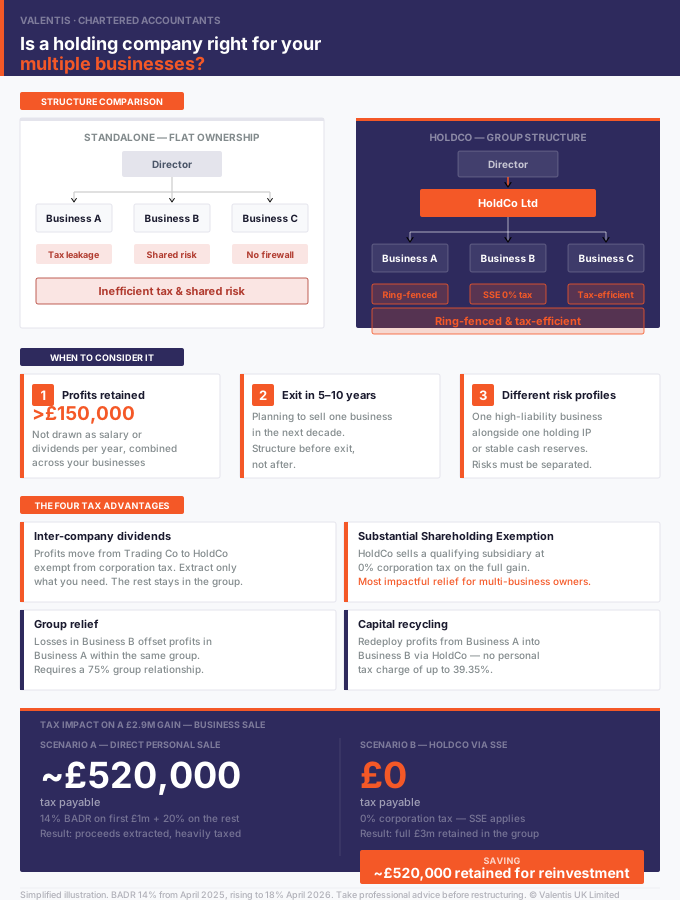
A holding company (HoldCo) is a UK limited company that owns the shares in your trading companies rather than trading itself. You sit at the top. HoldCo sits beneath you. Your individual businesses sit beneath HoldCo.
You (Director / Shareholder)
↓
HoldCo Ltd holds shares, accumulates profits, owns assets
↓ ↓
Trading Co A Trading Co B (and further subsidiaries)
You get there via a share-for-share exchange. HMRC treats this as a reorganisation rather than a disposal, so you do not trigger capital gains tax on the transfer. You need HMRC clearance before completing the exchange. Do not skip this step. A share exchange completed without clearance and later challenged by HMRC creates a significant problem.
Each trading company continues operating exactly as before. The change is at the ownership layer, not the operational layer.
The four tax benefits
1. Inter-company dividends
Dividends paid from a UK trading company to a UK holding company are broadly exempt from corporation tax. If Trading Co A generates £300,000 in profit and declares a dividend to HoldCo, HoldCo does not pay corporation tax on receipt.
You pay tax when you extract funds personally, not when they move within the group. The tax-free dividend allowance is £500 for 2025-26. Dividend tax rates above that are 8.75% (basic rate), 33.75% (higher rate), and 39.35% (additional rate). The point of the structure is that you only extract what you need. The rest sits in HoldCo for reinvestment.
2. Substantial Shareholding Exemption (SSE)
This is the tax relief most multi-business directors have never heard of. If HoldCo sells shares in a qualifying trading subsidiary, the capital gain is generally exempt from corporation tax. Completely. At any profit level.
Conditions apply: HoldCo must have held at least 10% of the shares for a continuous 12-month period in the six years before sale, and the subsidiary must be a trading company or trading group. When the conditions are met, the numbers are material.
Worked example: selling one of your businesses via HoldCo
| Item | Scenario A: Direct personal sale | Scenario B: HoldCo via SSE |
|---|---|---|
| Sale proceeds | £3,000,000 | £3,000,000 |
| Cost of shares | £100,000 | £100,000 |
| Gain | £2,900,000 | £2,900,000 |
| Tax rate | 14% BADR (first £1m), 20% above | 0% CT (SSE applies) |
| Tax payable | ~£520,000 | £0 |
| Saving | ~£520,000 retained in the group for reinvestment | |
Simplified illustration. BADR rate is 14% from April 2025, rising to 18% from April 2026. Assumes BADR available on first £1m of gain. Take advice specific to your circumstances.
3. Group relief
If one of your trading subsidiaries makes a loss, it can surrender that loss to offset against the profits of another profitable subsidiary within the same group. This requires a 75% group relationship. It removes the frustration of sitting on a loss in Business B while paying 25% corporation tax on Business A’s profits.
4. Retained profits deployed efficiently
If Trading Co A generates strong profits but you have an opportunity in Trading Co B, profits can flow tax-free via inter-company dividend to HoldCo and then be lent or invested into the other entity. Capital that would otherwise face personal tax charges on extraction can be redeployed within the group at no additional corporation tax cost.
Asset protection across your group
Running multiple businesses in a flat ownership structure means the operational risks of each company exist independently. A group structure with HoldCo creates a more deliberate risk architecture.
If a trading subsidiary encounters a serious claim, insolvency event, or contractual dispute, the assets held at HoldCo level are generally outside the reach of that subsidiary's creditors. This only holds if the group is properly maintained as separate legal entities with correct formalities.
| Asset / Exposure | Standalone structure | HoldCo structure |
|---|---|---|
| IP (brand, software, trademarks) | At risk | Ring-fenced in HoldCo |
| Cash and retained profits | Exposed to each company's risk | Held at HoldCo level |
| Property / premises | Sits in trading co | Transferred to HoldCo, leased back |
| Contract disputes in Trading Co A | Affects your ownership position | Contained within subsidiary |
| Trading Co B insolvency | No firewall with other entities | Other subsidiaries and HoldCo protected |
| Director personal liability | Ltd co protection applies | Same protection, cleaner structure |
If you are accumulating profits across two or more businesses, the structure question should have been raised two years ago. Book a call to see whether this makes sense for your specific group.
Get a free holding company review →When the structure does not make sense
A group structure adds administrative cost and complexity. Be honest about these four scenarios before proceeding.
Your businesses are very small. If combined profits are below £100,000 and neither business is likely to be sold, the compliance cost of maintaining a group outweighs the benefit.
You plan to sell personally and take BADR. Inserting a HoldCo before a sale can complicate matters. Timing the restructure correctly matters.
The businesses are completely unrelated and you want to keep them entirely separate. A group structure implies some degree of interdependence. Standalone may be cleaner.
Associated company effect on your corporation tax thresholds. The thresholds are divided by the number of associated companies. If you have three associated companies, the small profits rate threshold drops to roughly £16,667 per company. Two of your businesses could already be paying 25% corporation tax where they might otherwise qualify for 19%.
You own three companies, each with £60,000 in annual profit. Each is an associated company. The £50,000 small profits threshold is divided by three, giving each company a threshold of approximately £16,667. All three companies pay corporation tax at the main rate of 25%, despite individually having modest profits. Combined, roughly £45,000 in corporation tax. A sole company with £60,000 in profit would pay approximately £11,400 at the small profits rate. This distinction is real and often goes unmodelled.
How the restructure works
Establish the commercial rationale
Your accountant should document why the structure makes commercial sense. HMRC expects a genuine business reason. For multi-business directors this is usually straightforward: centralised capital management, risk separation, or future exit planning.
Incorporate the holding company
HoldCo is incorporated as a new UK private limited company. Straightforward Companies House registration. The name typically includes “Holdings” or “Group” but this is not a legal requirement.
Apply for HMRC clearance
This is the step that trips most directors up. Before completing the share-for-share exchange, you need advance clearance from HMRC under section 138 TCGA 1992. Allow four to six weeks.
Execute the share-for-share exchange
Once clearance is received, you transfer your shares in each trading company to HoldCo in exchange for shares in HoldCo. No cash changes hands. No CGT is triggered.
Update legal documentation and banking
Shareholder agreements, director service agreements, and bank mandates all need reviewing. If your trading companies have external shareholders, their consent is required. This step often takes longer than the tax clearance.
Establish inter-company arrangements
Management charges, intercompany loans, and service agreements between HoldCo and the trading subsidiaries need to be properly documented. Transfer pricing rules apply, even to small groups.
What it costs
| Item | Typical cost | Notes |
|---|---|---|
| HMRC clearance application | £1,500 – £3,000 | Usually included in accountant fee for the restructure |
| Legal advice | £2,000 – £5,000 | Varies by complexity and number of subsidiaries |
| HoldCo incorporation | £50 – £200 | Companies House filing |
| Accountancy (setup and first year) | £2,000 – £4,000 | Group accounts, intercompany agreements, CT modelling |
| Ongoing additional cost per year | £1,000 – £2,500 | Additional company accounts and compliance |
| Total one-off cost | £5,000 – £12,000 | Against a potential saving of £500,000+ on a £3m exit via SSE |
Three things specific to multiple-business owners that make this structure valuable
1. Capital recycling without personal tax leakage
If you own two businesses and Trading Co A generates profits you want to deploy into Trading Co B, the standalone route means paying yourself a dividend at up to 39.35% tax, then injecting that cash back in. Via HoldCo, dividends flow up tax-free and can be lent or invested back into any subsidiary without the personal tax layer. For directors actively building a portfolio of businesses, this is the core financial case. The compounding effect over five to ten years of retained capital is material.
2. Clean governance when selling part of the group
Via HoldCo, you are selling a subsidiary. The transaction sits at the group level. HoldCo retains the proceeds. If SSE applies, the gain is exempt. You can decide how and when to extract the proceeds personally, rather than being forced to take it all in a single tax year. For serial builders, this flexibility compounds significantly over time.
3. Separation of equity incentives by business
If you want to give equity to a key employee in Business A without giving them any stake in Business B, a group structure makes this straightforward. You create an EMI option scheme at Trading Co A level. The employee has exposure only to that subsidiary's value. In a flat ownership structure, managing this without a group is significantly more complicated, particularly if you later want to exit Business A cleanly.
Common questions
Five questions to ask your current accountant
These questions are worth raising at your next review. The answers will tell you quickly whether you are getting proactive advice or compliance-only service.
Have you modelled whether a holding company structure makes financial sense for my businesses? Not “here’s what it is.” An actual numbers comparison across a five-year horizon.
What are my effective corporation tax rates across my associated companies right now? Given the threshold division rules, is each company paying the rate I think it is?
If I were to sell one of my businesses in the next three to five years, what would my tax position look like under the current structure versus a group structure with SSE? Show me the numbers.
How are retained profits in my businesses currently being treated, and what is the most tax-efficient way to redeploy them? What does the tax cost of extraction and reinvestment look like under different structures?
Have you considered the EMI or share incentive implications for key staff in my businesses under a group structure? Are there better ways to incentivise people at the subsidiary level?
These are questions Valentis answers before you ask them. We model the structure, explain the numbers, and tell you whether it makes sense.
We raise holding company structures when they are right for multiple-business directors. Not when you ask.
If your combined profits are above £150,000 and you are not drawing all of it, the conversation should have already happened. Book a free director call and we will model whether the structure makes sense for your specific group.
This page is for general informational purposes. Tax law is complex and individual circumstances vary. Always take professional advice before making structural changes to your business. Valentis is a chartered accountancy firm registered in England and Wales.